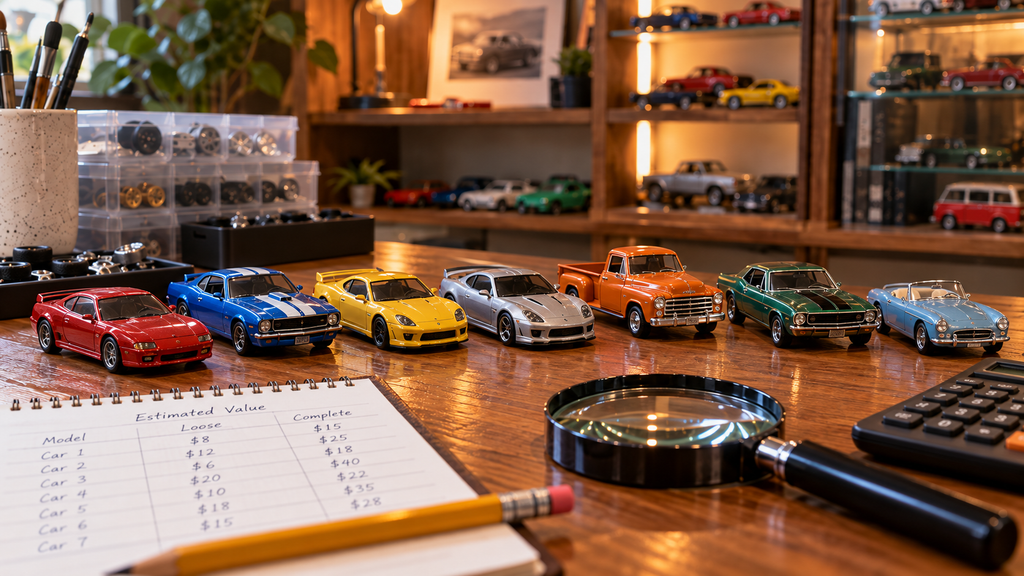
Disney and Pixar Cars die-cast vehicles have developed into a substantial collecting category, with characters, variations and packaging spanning many years.
If you have found an older Lightning McQueen, Doc Hudson, Mater or another Cars vehicle, the most important step is identifying the exact release before trying to value it.
A Cars toy that looks common at first glance may have packaging, production or variation differences that distinguish it from another release.
This guide explains what to check.
Market note: Collectible prices change constantly. Any values published by FunToyz Collector should be treated as market estimates rather than guaranteed selling prices.
| Character / Guide | What you’ll find |
|---|---|
| Lightning McQueen | Variations, identification and current market examples |
| Doc Hudson | Release identification and market research |
| Most Valuable Disney Cars | What makes certain releases more collectible |
| Rare Cars Identification | How to inspect markings, wheels, packaging and variations |
What Scale Are Disney Cars Die-Casts?
Many of Mattel’s core Disney and Pixar Cars character die-casts are marketed as approximately 1:55 scale.
That allows characters with very different real-world proportions to remain visually compatible as a collection.
Collectors should still identify the manufacturer and exact product because not every Cars toy belongs to the same range.
Start With the Bottom of the Vehicle
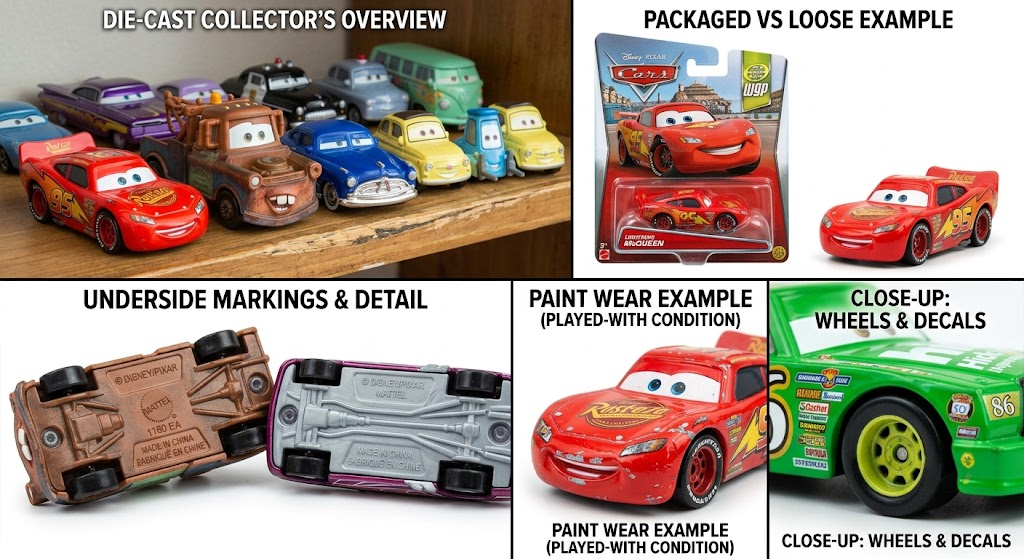
One of the most useful places to begin identification is the underside.
Look for:
- manufacturer markings
- Disney/Pixar copyright information
- manufacturing country
- product numbers
- production codes
- molded markings
- date information
Take a clear photograph before doing further research.
Do not rely only on the character’s appearance.
Identify the Character
For common characters such as Lightning McQueen, Mater and Doc Hudson, identifying the character is only the beginning.
The same character may have been released many times.
Look for differences including:
- facial expression
- eye position
- decals
- paint color
- wheel design
- accessories
- damage or racing decoration
- packaging
- manufacturer markings
Packaging Can Help Identify the Release
Original packaging is extremely useful.
Collectors may encounter Cars die-casts from different packaging periods and sub-series.
If you have an unopened example, photograph both the front and back of the card before removing the toy.
The back may contain information that helps identify the series and other vehicles available at the time.
Does Age Automatically Make a Cars Toy Valuable?
No.
An older toy is not automatically rare, and a rare toy is not automatically valuable.
A toy’s desirability can depend on a combination of factors.
Availability
Was the release widely distributed or difficult to find?
Character
Some characters naturally attract more collector interest than others.
Variation
A release with an unusual decoration, expression, accessory or packaging variation may attract more interest.
Condition
A clean example generally has greater collector appeal than one with significant paint loss or damage.
Packaging
Original packaging may increase desirability, particularly when both the toy and packaging are in excellent condition.
Demand
Ultimately, value depends on what collectors are actually willing to pay.
Loose vs Packaged Cars Die-Casts
A loose Cars die-cast can still be collectible.
For loose examples, inspect:
- paint chips
- scratches
- wheel condition
- bent axles
- missing pieces
- stains
- marker or paint added by a child
- rust or corrosion
- damage to plastic parts
For packaged examples, also inspect:
- cracked blisters
- yellowing
- crushed corners
- creases
- price stickers
- water damage
- card fading
- whether the package appears to have been opened
How We Research Value
FunToyz Collector does not assign value based solely on age.
Our preferred approach is:
Step 1: Identify the exact version.
Step 2: Assess condition.
Step 3: Compare equivalent examples.
Step 4: Review current marketplace availability.
Step 5: Consider recent selling evidence where available.
Step 6: Publish a dated market estimate rather than a permanent claim.
Current Market Check
Market research updated: August 2026
Disney and Pixar Cars die-casts do not have one meaningful overall price range. Common modern releases can sell for only a few dollars, while particular discontinued, packaged or documented variations can sell for considerably more.
For example, recent 2026 eBay sales for Lightning McQueen variants ranged from under $5 for some loose examples to $100 for a specific Final Lap Muddy Lightning McQueen. Doc Hudson examples likewise varied substantially depending on the exact release.
For this reason, FunToyz Collector researches individual characters and variations rather than assigning one generic value to all Cars die-casts.
Use the individual character guides below for more specific market research.
Prices shown on FunToyz Collector refer to observed market evidence and are not appraisals. Shipping, tax and seller fees are not included unless specifically stated.
Where to Check Current Prices
Online marketplaces are useful because they show what is currently available.
However, there is an important difference between an asking price and a selling price.
A seller listing a toy for $200 does not mean the toy is worth $200.
Compare several examples and make sure they are actually the same release.
Popular Disney Cars Collector Guides
Start with these detailed collector guides:
Lightning McQueen Diecast Value Guide — identify Lightning McQueen variations and compare recent market examples.
Doc Hudson Diecast Value Guide — identify Doc Hudson releases and understand the factors that affect value.
Most Valuable Disney Cars Toys — learn what makes particular Disney Cars releases more collectible.
How to Identify Rare Disney Cars Diecasts — use base markings, packaging, wheels and other details to identify your toy.
Disney Cars Value Guides by Character
| Character | Guide |
|---|---|
| Lightning McQueen | Lightning McQueen Diecast Value Guide |
| Doc Hudson | Doc Hudson Diecast Value Guide |
| Mater | Mater Diecast Value Guide |
| Chick Hicks | Chick Hicks Diecast Value Guide |
| The King / Strip Weathers | The King / Strip Weathers Diecast Value Guide |
| Sally Carrera | Sally Carrera Diecast Value Guide |
Frequently Asked Questions
Are old Disney Cars toys valuable?
Some can be desirable, but age alone does not create value. Release, rarity, condition, packaging and collector demand all matter.
How do I know which Cars die-cast I have?
Start with the character, then examine the underside, packaging, decals, wheels, facial expression and production markings.
Are unopened Cars toys worth more?
Sometimes, but not automatically. The exact release and the condition of the packaging both matter.
Should I clean an old Cars die-cast?
Avoid aggressive cleaning, solvents or abrasive products. Altering original paint or markings can reduce collector appeal.
Where should I start?
If you are new to collecting, identify your vehicle first and only research price after determining the closest matching release.
7 thoughts on “Disney Cars Diecast Value Guide”